
The Morgan County Most Wanted Program
Morgan County has no public online most-wanted roster. The Morgan County Sheriff's Office site links to Case Information through MyCase. It also carries the County Jail, public-record requests, crime tips, news, and data. No warrant search page appears anywhere on it. Read the gap narrowly. It does not mean Morgan County lacks active warrants or wanted persons. It means the county publishes no public roster of them, with no names, photographs, or reward terms posted. A neighboring county's list cannot stand in for an official Morgan County record. A private aggregator cannot either. Go to the case record itself, then confirm with the issuing court.
No Morgan County Roster Found
Missing a roster is not the same as missing warrants. An agency can serve warrants without listing them. A warrant may sit in a restricted case. It may follow a recent court event or a local court, or simply never be indexed online. Morgan County points the public to case information and records channels instead. For records the Sheriff holds, the Sheriff public-record request page explains how to ask the office directly.
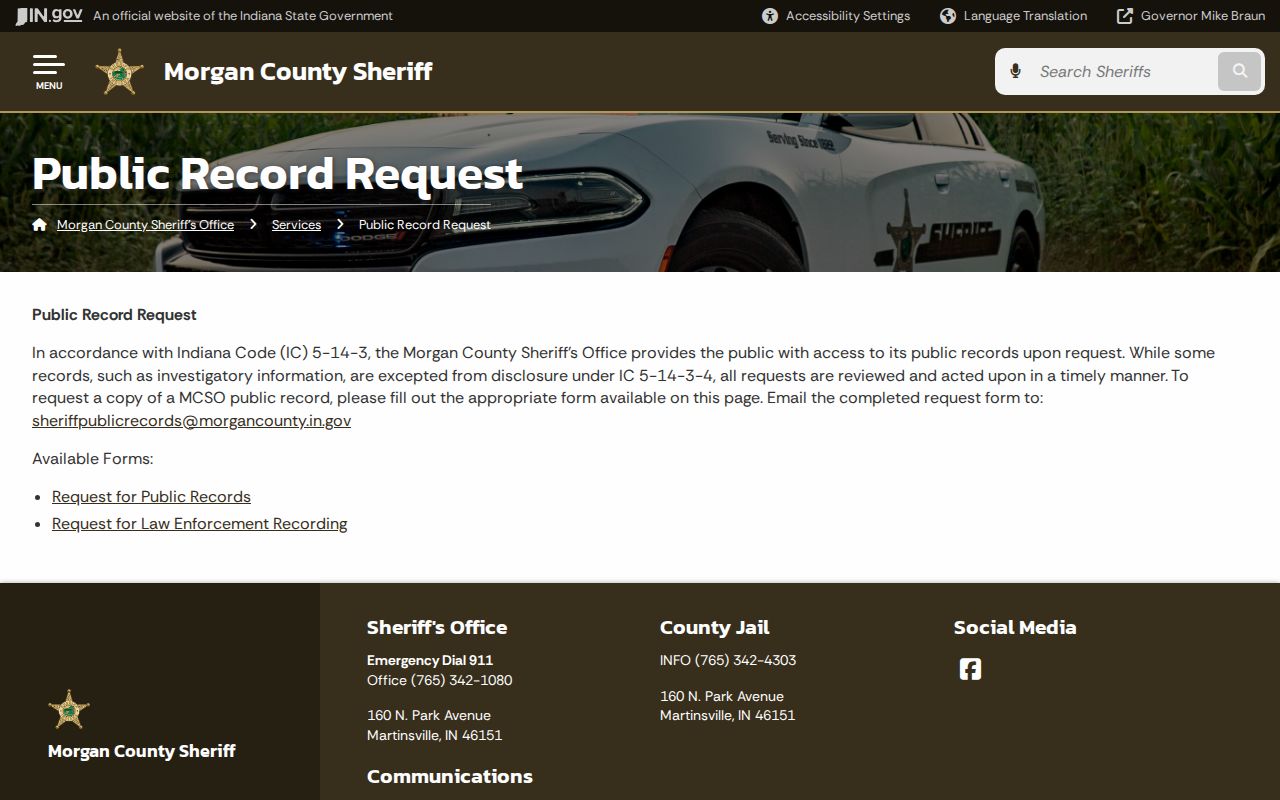
The Indiana Access to Public Records Act route can seek a particular Morgan County record the Sheriff holds. It is not a hidden most-wanted list. It is not a live warrant check either. Investigatory information and other APRA exceptions may limit what gets released.
How the Lists Work
Where an agency posts one at all, a most-wanted list is a hand-picked notice, not the full set of active warrants. Selection is a judgment call, not a count. Morgan County publishes no such roster. That means the county has posted no selection criteria, update schedule, disclaimer, or reward policy for anyone to read. No update schedule exists to check. A worthwhile Morgan County roster would name its government custodian, its last update, and the issuing court or agency behind each entry. It would state its status limits plainly. It would also warn readers that warrant status can change and that any list may be incomplete. Note: an official roster belongs on its agency's own site, never copied into a locally hosted list of names or images.
Morgan County Status Verification
Indiana MyCase is the main online lead for a Morgan County court record. Search it by case number, citation, cross-reference, party, attorney, court, case type, status, or date range. A broad search can hit the result limit. Sounds-like and trailing-wildcard options help with spelling, and a date of birth narrows a party search without being displayed.
- Search Indiana MyCase using the strongest identifier and a Morgan court filter.
- Review eligible docket events for a warrant, hearing, recall, service, bond, or disposition reference.
- Call the issuing court or Morgan County Clerk at 765-205-1548. Records staff can be reached at 765-205-1601.
- Use the Sheriff at 765-342-1080 or non-emergency communications at 765-342-5544 for suitable routing.
MyCase is not a live warrant database. Treat any Morgan County docket result as a lead until the court confirms the current procedural status.
How to Report a Tip Safely
A Sheriff's news item lists crimetips@morgancounty.in.gov and Crime Stoppers of Central Indiana at 317-262-8477 for tips. Morgan County runs no recurring most-wanted program, reward schedule, or roster partnership. Ask the receiving program what it offers. Anonymity and rewards depend only on what that official program states.
- Use a published Sheriff or Crime Stoppers channel, not a social-media reply or private intermediary.
- Give concise facts about what was observed, when, and where. Do not confront or follow anyone.
- Call 911 only for an emergency or immediate threat. Use non-emergency contacts for routine information.
- Do not use the tip line to ask whether you or a relative has a warrant. Contact the court instead.
Tip safety: Report facts through an official channel, avoid confrontation, and let trained authorities decide whether information relates to an active case.
Tips Are Not Warrant Searches
A crime-tip inbox collects information about crimes or about people law enforcement is seeking. It keeps no court docket. It cannot tell you whether a warrant is still current. Morgan County warrant status stays a question for the court and the Clerk, while the Sheriff handles service, the jail, routing, and its own records. The Morgan County Jail page is not a most-wanted list either. Booking and custody data describe a different stage entirely. Someone can have a court record and never spend a night in custody. A jail page also cannot show every court warrant. Keep each official source inside its role. For a relative, gather the court or case identifier and follow the same confirmation route. Never post a person's name, photograph, address, or claimed status to crowdsource help. That spreads stale or false information and sidesteps court access rules.
Most Wanted vs an Active Warrant
The two terms overlap without matching. A most-wanted notice is one agency's chosen publication. An active warrant is court process still available for service. Morgan County can hold active warrants even with no public online roster from the Sheriff.
| Point | Most-wanted notice | Active warrant |
|---|---|---|
| Source | Selected official publication, if one exists | Issuing court and law-enforcement systems |
| Coverage | A curated subset | Broader process, including unpublished records |
| Morgan availability | No official roster found | Status checked case by case |
| Currentness | Agency update and disclaimer | Current court confirmation |
| Public use | Official notice and its tip route | MyCase lead and court contact |
The Morgan County active warrants reference explains the broader no-roster finding.
Morgan County Records Request Limits
A records request works best when it names one thing. Under Indiana's APRA, you can ask the Morgan County Sheriff for an incident report, a citation, or another reasonably particular Sheriff record, and the official form asks for a date range, incident details, location, record type, and a case or UTT number when you know it. What it does not promise is a fixed turnaround, free copies, or every detail, since Indiana law can shield investigatory material, juvenile information, sealed records, and confidential content. Courts and the Sheriff also keep different files, so send your ask to the right office. The Morgan County Clerk handles a public docket, order, or court copy, while the Sheriff holds incident, service, return, booking, and agency records. If an office says a record is not maintained there, that may just mean the request went to the wrong place, and it does not answer the warrant question. Request one identified record rather than a bulk list, and skip republishing any person-specific result.
Morgan County Warrant Data Ages
A docket entry can change things fast. Status shifts after an entry or notice appears, and the Indiana State Police validation procedure explains part of the rhythm: law enforcement validates warrants every 30 days, an ordinary misdemeanor warrant expires 180 days after issue, and a reissued misdemeanor warrant does not expire. That procedure is not a public lookup tool, though, and it cannot declare an old warrant gone. A warrant may also be served, recalled, quashed, or reissued, with recall and quash being court actions that withdraw or set aside process, so exact docket wording matters. An old public entry may not show a later restricted or delayed update either. Before travel, payment, or an appearance in Morgan County, ask the issuing court for the present status of any warrant.
Currentness warning: Neither an old docket event nor silence on a public list proves the present status of a Morgan County warrant.
If You Believe You Are on a List
Morgan County posts no most wanted list, so treat any third-party post claiming to reproduce one with doubt. Save where it came from, check whether it points to an official county page, and call the issuing court, Clerk, or Sheriff yourself through a published government number. An attorney can explain appearance, bond, surrender, and filing options without you reacting to a caller's demand. If a situation feels unsafe or unclear, learn the official procedure before approaching law enforcement. The issuing court may want a scheduled appearance, a filing, bond, or counsel contact. The Sheriff can explain routing and custody procedures but cannot replace the court's order. Martinsville City Court and Mooresville Town Court each handle their own local cases, so contact that court directly. One more caution: Morgan County's Sheriff has warned about scammers who falsely claim a warrant and demand payment. Never pay by gift card or a caller's link. Hang up, find the official number yourself, and verify, since federal fugitive and PACER systems cover federal warrants, not a Morgan County roster.
Morgan County Most Wanted Source Standards
If Morgan County ever posts a most-wanted roster, stay with the official source. Check that the page sits on a real Sheriff or government domain. Note who keeps it, when it was last updated, and how to reach that office. A warning that the list is incomplete matters too, since a recall, service, dismissal, or new court order can leave stale copies of a name floating elsewhere. A clipping shared on social media can outlive the facts. The live official page and the issuing court win every time. Do not borrow a roster from another Indiana county, a federal fugitive page, or a paid name-search service. Each one answers to its own authority. A U.S. Marshals task-force page may describe federal fugitive work, but it cannot establish a Morgan County warrant. PACER covers federal dockets only, not city, town, Circuit, or Superior Court cases. When you need a public record, ask for the smallest one that answers the question. A case number, date range, court, incident type, or UTT number helps identify it. Aggregate totals without names can inform the public without copying a list of people, and no statistic should be claimed unless an official source supplies it.